
Bioidentical Hormone Replacement Therapy (BHRT) and the Body’s Natural Endogenous Hormones
Since Bioidentical Hormone Replacement Therapy (BHRT) has gained popularity in recent years, patients often ask me about its effects compared to hormones regulated by the body’s natural Hypothalamic-Pituitary-Ovarian (HPO) Axis.
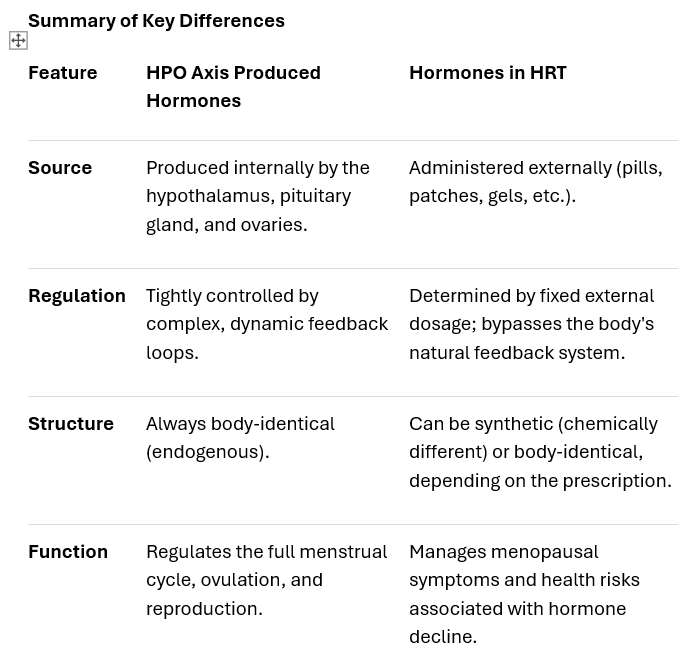
The main difference is that the hypothalamic-pituitary-ovarian (HPO) axis is a natural, tightly regulated internal feedback system that produces endogenous (body-identical) hormones, whereas hormone replacement therapy (HRT) involves externally administering hormones, which may be synthetic or body-identical, that a woman’s body no longer produces sufficiently, usually after menopause.
HPO Axis Produced Hormones; The HPO axis is a complex endocrine system essential for female reproduction, involving a cascade and feedback loops across the hypothalamus, pituitary gland, and ovaries. The HPO axis releases gonadotropin-releasing hormone (GnRH), which stimulates the pituitary to produce follicle-stimulating hormone (FSH) and luteinizing hormone (LH). FSH and LH, then, act on the ovaries to produce sex steroids, primarily estradiol (the main estrogen), progesterone, and small amounts of testosterone. Hormone secretion is precisely controlled by intricate positive and negative feedback loops, ensuring cyclical, balanced production throughout the menstrual cycle. These hormones regulate pubertal development, the menstrual cycle, ovulation, and prepare the uterus for potential pregnancy. The body produces these hormones endogenously, and their structures are the “original” chemical blueprints for human function.
Hormones in HRT; HRT is a medical treatment designed to replace the hormones that a woman’s ovaries produce less of, typically due to aging and menopause. HRT typically involves administering estrogen (e.g., estradiol) and often a progestin (a synthetic progesterone) or progesterone. Synthetic hormones (e.g., some oral estrogens like Premarin and synthetic progestins) are chemically altered, meaning their structure is similar to, but not exactly the same as, naturally produced hormones. These structural differences can influence how the body processes them and may be associated with different side effects or risks.
Body-identical hormones (e.g., transdermal estradiol gels/patches and micronized progesterone) are manufactured from plant sources but are structurally identical to the hormones produced by the human body. Regarding its regulation, the HPO axis is bypassed. Hormone levels are determined by the medication’s dosage and delivery method, rather than by the body’s internal feedback system. The goal is to alleviate symptoms of menopause (such as hot flashes) and prevent associated conditions like osteoporosis by maintaining a more stable, albeit externally regulated, hormone level.
For more information and Fertility Treatment consultations, please contact and visit us at www.doctorkits.ca
Naila Gaber, Ph.D., R.Ac, R.TCMP
Visiting Scientist, Morinomiya University of Medical Sciences, Osaka, Japan
Member of The University of Toronto Centre for the Study of Pain (UTCSP)
DK – Holistic Health Clinic
www.doctorkits.ca
647-334-7440

